

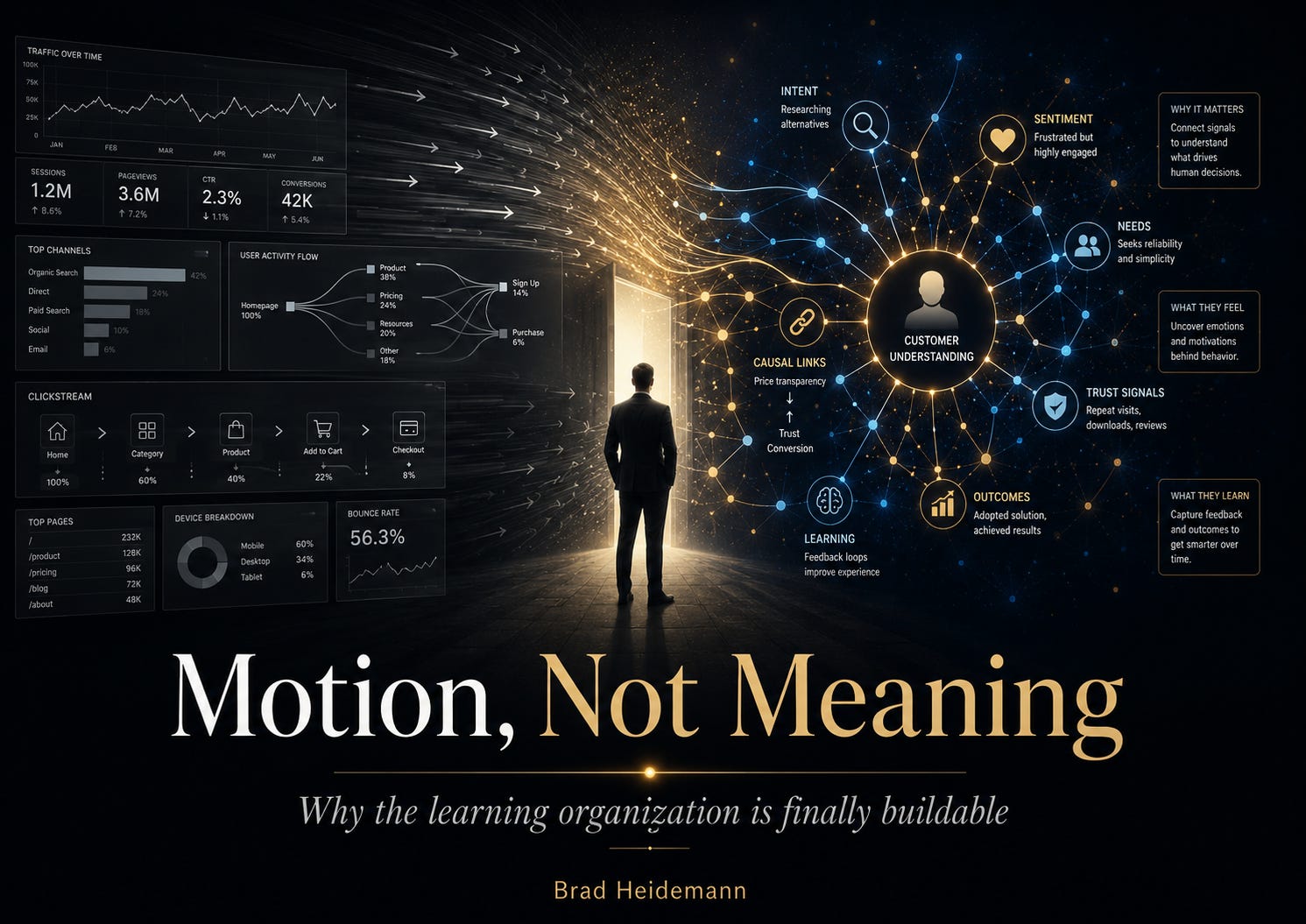
Every number has a story to tell. In the first essay in this series, I argued that the agentic foundation is taking shape and the knowledge graph holds the plot. (New to knowledge graphs? I wrote a primer on what they are and why the most valuable thing your company knows has never been written down.) This essay states the central claim of the series plainly, because burying it would be a disservice: the learning organization is finally buildable. The enterprise that understands its customers better every day, that compounds what it learns instead of merely recording what it did, has moved from leadership aspiration to engineering decision. Here’s the story of why that’s suddenly true.
Start with the assumption that has to go: that your company understands its customers because it measures them. We have superb mathematics for operations. Supply chains, logistics, labor productivity, same-store sales, cash conversion: fifty years of enterprise systems made the what of business precise to the decimal. None of that precision explains why a customer trusted you in March and hesitated in June. We measure everything that happens and almost nothing about why.
That’s not a technology gap. It’s a cognitive one, and behavioral economics spent fifty years documenting it. Daniel Kahneman and Amos Tversky showed that we reason from whatever information is most available, and that when a question is hard, we quietly substitute an easier one and never notice the swap. ‘Why are customers leaving?’ is hard. ‘What did conversion do last week?’ is easy. So the Monday review answers the easy question and files it under the hard one. In Thinking, Fast and Slow, Kahneman gave the pattern a name: what you see is all there is. The dashboard becomes the whole story precisely because it’s the story on the screen. Humans are bad at causality, brilliantly bad, in predictable directions. Marketing didn’t decide to ignore why. It inherited instruments that made the bias structural. We industrialized System 1 and called it analytics.
Watch the bias play out in a company you’d recognize. In March, the onboarding refresh ships. The copy is cleaner, more confident, more feature-led. Completion rates hold, the dashboard stays green, the team moves on. But the new language has quietly stopped answering a question first-time customers need resolved before they commit. A cause is now in motion, and no instrument in the building can see it. Through April, that missing question surfaces again and again in support conversations. In May, customer language in those conversations turns less certain. In June, activation dips. In September, renewals miss, and the room does exactly what Kahneman would predict: it reaches for the most available explanation. Pricing pressure. A competitor’s launch. Seasonality. The March decision is six months old and three handoffs away, and because it was never measured, it’s never suspected. The company doesn’t learn the lesson. It buys a better churn model.
Multiply that story across every page, campaign, and conversation the enterprise ships in a year, and you have the real cost of counting: not one soft quarter, but an organization that repeats its mistakes with increasing efficiency. That’s the quiet tragedy of modern marketing. The discipline didn’t lose its craft. It buried the craft under a MarTech stack that automates activity without understanding it, and the newest AI content tools are making it worse, regressing every brand toward the statistical mean, faster and cheaper than ever.
Now run the same story with instruments that can read. Same company, same March refresh. This time the copy ships into an agentic infrastructure: AI agents, built on frontier models like Claude, that read every asset the way your best brand mind would, and a knowledge graph that keeps content, customers, conversations, and outcomes connected across time. Within days, semantic analysis flags that the new copy has drifted from the questions first-time customers actually ask. That isn’t intuition. It’s a measured distance between two mental models. By April, the system reads sentiment decaying in support conversations and scores it with enough mathematical precision to alert on: customers are measurably less confident, on specific pages, about specific promises the brand made. The Monday review doesn’t open with an argument over attribution. It opens with a causal thread the junior analyst can trace as easily as the CMO, because the thread lives in the graph, not in a veteran’s head. The team forms a hypothesis, tests a revision, and the enterprise remembers the answer either way. Marketing stops performing certainty and starts practicing curiosity.
This is the company Peter Senge described a generation ago in The Fifth Discipline: the learning organization, where understanding compounds. Executives loved the idea, and once you’ve seen both versions of March, you know why. Almost nobody could build it, because you can’t run a learning organization on instruments that record without compounding and obscure causality by design. That’s the decision in front of leadership now, and it’s genuinely new. Keep optimizing the counting, or build the reading. Keep the stack that measures motion, or add the layer that measures meaning.
The rest of this essay shows what that layer reads and how the loop closes. The techniques exist today, grounded in decades of research, from computational linguistics to semiotics to the behavioral science above. For the first time, we have a genuinely granular understanding of language, and we can see its effect on customers at ever finer segmentation. There’s still a great deal to learn about how humans experience content, what moves them, and what they find pleasing. That’s not a caveat. It’s the point: those questions are finally answerable by instrument instead of argument. And the argument of this essay needs only one sentence: that organization isn’t measuring more. It’s measuring differently.
Motion, not motive
For seventy years we’ve lived under the most quoted line in management: what gets measured gets managed. The problem is what we chose to measure. We counted impressions, clicks, bounce rates, and conversions because they were easy to count, which is the availability bias wearing a lanyard. So marketing became exceptionally good at describing motion and stayed surprisingly weak at explaining motive.
Attribution tells you which door the customer came through. It doesn’t tell you why they knocked. A conversion rate hands you the last sentence of a story with every page before it torn out. And because activity metrics arrive fast while changes in trust and comprehension arrive slow, the available numbers drag every decision toward the short term.
That’s how the flywheel starts spinning backward. Trust erodes quietly for three quarters while the dashboards stay green. By the time a metric turns red, the decision that caused it is six months old and three handoffs away.
A learning organization can’t run on instruments that only see the last click. It needs instruments that preserve context, surface patterns, and help the enterprise test why.
Content is an intervention, not inventory
Start with the asset the enterprise measures worst: its own voice. Most companies manage content as inventory, a production queue of pages, campaigns, and assets to ship and eventually replace. But every message, image, and interaction is also an intervention in the customer relationship. It shapes emotion, understanding, intent, and action, right alongside price, product, and service.
Which makes every piece of content a live experiment, whether the company designed it as one or not. Most organizations record what the content cost and how many people clicked it. Almost none measure what changed after exposure: comprehension, confidence, trust, the customer’s sense of what the brand stands for. For decades that was fair, because meaning couldn’t be measured consistently at scale. AI doesn’t make meaning perfectly measurable. It makes meaning observable, comparable, and monitorable, and that’s enough to change the job.
Five ways to read
AI can now read content across dimensions that used to live in expert judgment, and it can do it across thousands of touchpoints at once.
Style and tone. Style isn’t decoration. It’s a credibility signal. Measured across channels, tone reveals whether the brand sounds like one company or twelve. Consistency of voice doesn’t create trust by itself. Inconsistency quietly spends it.
Sentiment and emotional framing. Emotion leads. Behavior lags. Excitement, confusion, skepticism, and frustration show up in customer language before they show up in retention or revenue, which makes sentiment the earliest tripwire you can set.
Semantic clarity. Does the content match the customer’s mental model or the org chart’s? A customer never reports that your taxonomy is confusing. They just fail to find the next step, abandon the journey, or call support. Confusion doesn’t file a complaint. It leaves.
Semiotic signals. Customers read symbols: color, imagery, category cues, ritual. A brand is a set of expectations customers learn to predict, and every asset either keeps that promise or breaks it. Semiotic drift is how a brand blurs while every individual asset still looks good.
Behavioral correlation. The payoff dimension: connecting content attributes to downstream outcomes. Did the warmer tone precede more qualified demo requests? Did the revised onboarding precede higher activation? Correlation doesn’t settle the question. It tells you where to look and what to test.
These aren’t replacements for financial or behavioral metrics. They’re explanatory signals, and they can’t live in another disconnected spreadsheet. They belong in the knowledge graph from the first essay, where a content version, a customer segment, a support theme, and a renewal decision stay connected across time. The graph holds the plot. These dimensions are how you read it.
What reading looks like
Go back to the March story and look at the mechanics. The connection between the content version, the language shift, the affected cohorts, and the later outcomes produced a causal hypothesis, not a verdict. Correlation opened the investigation. The test closed it. The team ran the revised sequence against the original, controlled for customer mix, and watched whether comprehension, activation, and retention moved together. The result fed back into the graph and sharpened the next diagnosis.
Notice what happened to the people in that story. Nobody got blamed for a red number. A hunch became a hypothesis, the hypothesis became a test, and the test became institutional memory. That’s Senge’s discipline made operational: the system learned, and so did everyone who touched it. Analytics reports what happened. Reading builds an explanation, tests it, and remembers.
From campaign metrics to system health
This changes marketing’s job description. Campaign measurement asks whether a burst of activity worked. System measurement asks whether the relationship is getting stronger, clearer, and more coherent over time. The first question produces reports. The second produces learning.
Read this way, marketing becomes the sensory system of the learning organization. It detects a change in customer confidence while it’s still a whisper. It catches the gap between the promise, the experience, and the outcome. It feeds what the market is teaching back into product, service, and strategy instead of trapping the lesson inside a campaign recap nobody reads. And it gives marketing’s craft knowledge, the instincts about language, story, and emotion dismissed as soft for decades, a way to become observable, testable, and scalable.
That’s the promotion marketing has been waiting for. Not a bigger budget. A bigger job: teaching the enterprise what its communication changes, for whom, and with what consequences.
What happens next
What gets measured gets managed. That won’t change, and it shouldn’t. What’s changing is what the enterprise can observe. Trust, clarity, resonance, and coherence are still imperfect constructs. They no longer have to be invisible ones.
The timing matters. Generative AI is flooding every channel with more content, made faster and cheaper. Production is becoming abundant. Understanding isn’t. The companies producing the most content and the companies learning the most from their content are about to become very different companies.
The sequence only runs in one direction. Measure meaning. Find the pattern. Form the hypothesis. Test it. Feed the result back. Skip the test and correlation becomes certainty theater. Skip the feedback and the enterprise repeats the lesson without learning it. Complete the loop and understanding compounds.
The executive question
There’s a test you can run this week, and it costs nothing. In your next marketing review, pick any number on the dashboard and ask why it moved. Then ask three more questions. What evidence connects the proposed cause to the outcome? What competing explanation fits the same facts? What test would tell them apart?
If the conversation stops at attribution, you have counting instruments. If the team can trace the relationship across content, context, behavior, and time, and can say how it would test the explanation, you’re building reading instruments.
That’s the decision in front of leadership. Not whether to measure, but whether to design the organization to learn: from every customer interaction, in real time, with causation you can trace instead of guess. I use a structured assessment to evaluate whether a company’s content, data, semantic, and feedback architecture can support that design, and where the learning loop is breaking.
Because the payoff compounds. Run the loop end to end, interaction after interaction, and the advantage isn’t a model or a platform a competitor can license. It’s an enterprise that understands its customers a little better every day, and people who get smarter along with it.
The learning organization was never a fantasy. It was waiting for its instruments. They’re here.
Next in the series: The Enterprise Learning Loop, how observation becomes hypothesis, evidence, institutional memory, and better action.
Disclosure: I have a commercial interest in this space. I build and advise on semantic AI, knowledge graph technology, and customer experience measurement systems.