

Thirty-six years ago, Peter Senge described one of management’s most admired organizational ideals: the learning organization. An enterprise that sees whole systems instead of isolated events. That senses cause and effect across months, not moments. That gets smarter with every customer interaction. Generations of executives read The Fifth Discipline, nodded, and went back to their dashboards. The tools existed in fragments. The integrated learning loop did not.
The integrated tooling exists now.
Picture it in practice. A company that hears a complaint while it’s still a whisper, before it becomes churn. That remembers why each customer arrived, not just what they clicked last week. That can trace this quarter’s revenue to last year’s decision and feed the lesson into the next one. A company where every interaction teaches the system, and the system makes every next interaction better. That’s not a metaphor for good management. It’s an architecture, and for the first time, you can build it.
The foundation is necessary. It is not sufficient.
Databricks just published its executive playbook for the agentic era, The New Architecture of Agentic AI, and it’s worth your time. More than twenty executives, one consistent message: outcome first, data layer before everything, governance as the engine rather than the brake. I’ve spent thirty years building digital experience platforms for global enterprises, and I agree with nearly all of it. The industry is converging on the foundation, and that’s genuinely good news. A meaningful enterprise consensus has formed.
But a foundation is a floor, not a finish line. The ebook’s own diagnosis points at what comes next: the models are smart enough; what they lack is context. Correct. So where does context come from? Not from a setting you configure or a layer you license. Context is meaning, accumulated over time. And meaning begins with a claim your dashboards were never built to handle.
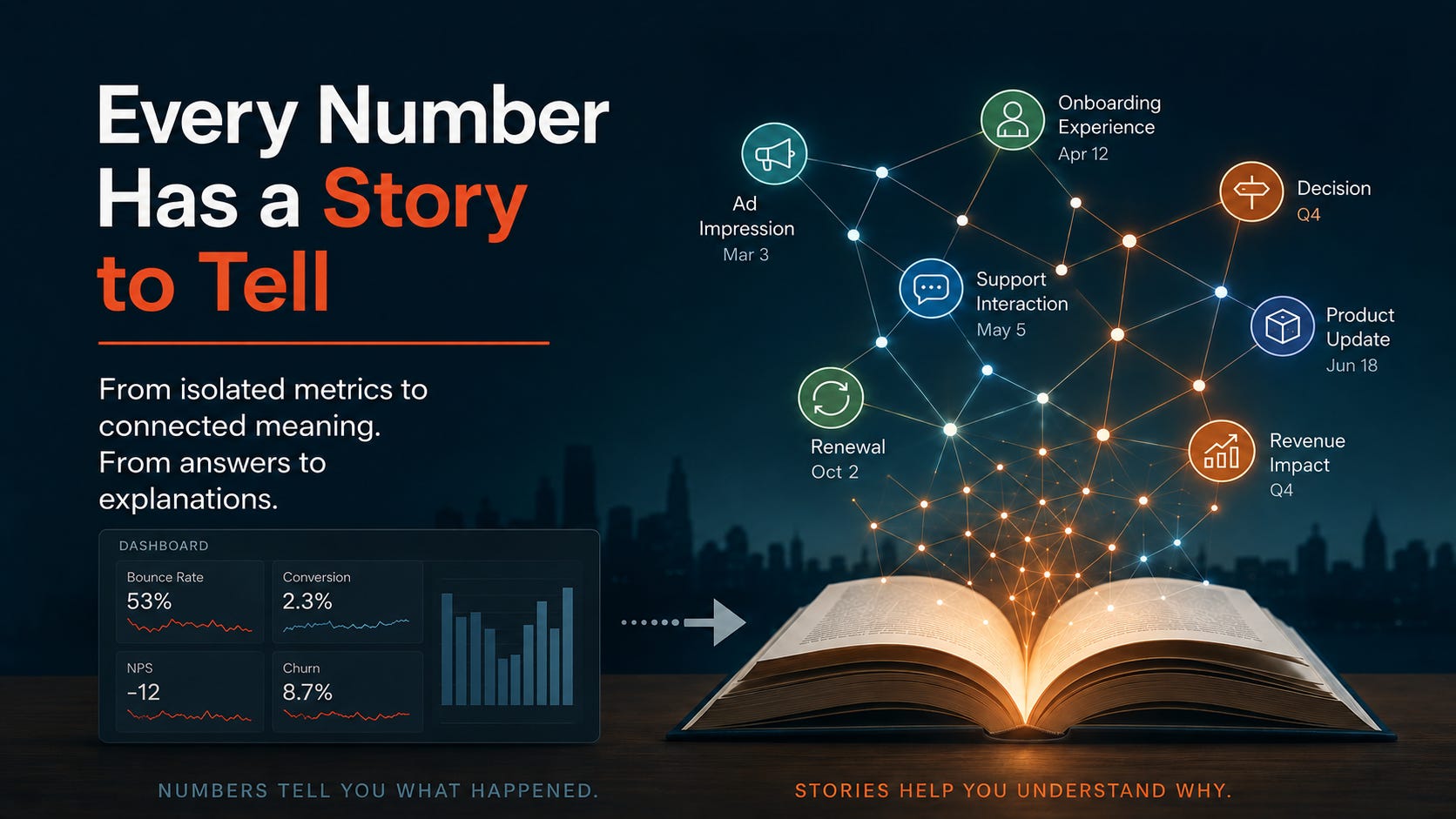
Every number has a story to tell
Bounce rate tells you someone left, not what went wrong. Conversion tells you someone bought, not whether they’ll come back. Two decades of analytics have taught the enterprise to count everything and explain almost nothing. We’ve been taking temperatures and calling it diagnosis.
Senge saw why. Humans are poor at reading causality in complex systems. When cause and effect are separated by months, we judge decisions by the events nearby instead of the chain that produced them. A company trims brand investment to make a quarter. Sales soften two quarters later, so it trims again. Each cut is rational. Together they’re a flywheel spinning backward, and nobody in the room can see it, because the delay defeats intuition.
A number is the last sentence of a story that started somewhere else, some time ago. Today’s dip in Net Promoter Score may trace to a clumsy onboarding flow from last spring, or to advertising that promised more than the product delivered. The number is the symptom. The story is the structure. Read only the numbers and you’ll manage the symptoms forever.
Rows hold the nouns. Graphs hold the plot.
Stories don’t fit in rows and columns. A story is entities in relationship over time: this customer, that promise. This content, that moment. This decision, that outcome, six months apart. Relational data holds the nouns. The graph holds the plot.
So extend that consensus one layer up. The semantic layer in today’s playbooks is a dictionary: governed definitions of “active customer” and certified margin numbers. Necessary, and most enterprises still haven’t built it. But a dictionary defines words. It doesn’t tell stories. To follow the chain from an ad impression through an onboarding stumble to a renewal decision, the enterprise needs a persistent relational model of meaning over time. For complex, longitudinal customer journeys, a knowledge graph is the natural architecture: customers, content, products, policies, and moments, connected by relationships a machine can traverse.
Semantic enrichment is the discipline that builds and maintains it. It binds meaning to data across the customer, the content, and the context of the interaction. It works across structured and unstructured sources, and it defines relationships dynamically instead of rebuilding the database every time the business changes. Once the graph is in place, an agent stops retrieving isolated records and starts traversing relationships across time. A graph does not prove causality, but it preserves the structure needed to form and test causal hypotheses. That is the difference between producing an answer and constructing an explanation.
A garden, not a monument
A knowledge graph is a garden, not a monument. Monuments get finished, dedicated, and photographed. Gardens get tended, because everything in them is alive. Products change. Policies get revised. Language drifts. Customers evolve. The graph is a living model of the enterprise, and living models need curators.
The emerging architecture consensus is right that governance is the engine, not the brake. Curation is governance applied to meaning. Someone has to own the ontology the way finance owns the ledger: adding what’s new, retiring what’s dead, reconciling what conflicts. Stop tending the garden and context decays silently. The agents keep answering, confident and polite, from a model of a company that no longer exists. Semantic initiatives rarely fail loudly. They fail by standing still, declared one and done, while the enterprise moves on without them.
Context is what customers feel
All of this cashes out at the one place strategy becomes experience: the customer.
Basic personalization says, “I know your name.” Contextualization says, “I understand what you need next.” The first is a lookup. The second requires persistent relational memory: who this person is, what they’ve been through with you, and what moment they’re in right now. And the experience has to fit the context, not just the message. Channel, tone, interface, timing. A correct answer in the wrong register, at the wrong moment, on the wrong surface, is still a failed experience.
Agents raise the stakes because agents remove the pause. A dashboard built on a wrong assumption sits there until an analyst questions it. An agent with governed data and no customer context doesn’t fail loudly. It fails politely, at machine speed, with perfect lineage: factually correct, well-governed, and contextually irrelevant.
Built to listen
Put the pieces together and Senge’s aspiration becomes an operating loop. The foundation holds the facts. The graph holds the story. Curation keeps the story true. Agents act on it in the moment. Instrumentation records what happened. Evaluation tests whether the intervention worked. The result feeds back into the graph, sharpening the next interaction. Without that loop, the system accumulates history but does not necessarily learn. With it, the enterprise stops reacting to symptoms and starts seeing structures. It catches the reinforcing loop while it’s still forming. It remembers each customer relationship across years, not sessions. It learns.
And learning compounds where technology doesn’t. Model advantages decay quickly. Platforms converge. Accumulated understanding of your customers is the one asset a competitor can’t license, because nobody can copy what your customers taught you.
One of the sharpest lines in the Databricks ebook comes from Stephen Ecker, chief data officer at Trinity Industries: “The data layer is the strategy.” At the infrastructure layer, he is right. At the experience layer, the story is the strategy. The foundation determines what the enterprise can know. The learning loop determines whether it gets smarter.
Every number has a story to tell. The companies that pull ahead will be the ones built to listen.
Disclosure: my company builds knowledge-graph infrastructure for enterprise AI, so I have a commercial interest in this argument. I'd make it anyway.